CND Services: UT, RT, PAUT, TOFD, MT, PT, VT exams | General Control CND

Our Expertise in Non-Destructive Testing

In the industrial world, the safety and reliability of structures and components are not optional, but essential requirements. Therefore, our company is committed to providing top-notch Nondestructive Testing (NDT) services, ensuring that every product, weld, and material meets the most rigorous quality standards.

We use a combination of cutting-edge techniques and the extensive experience of our team of certified professionals. Our mission is to identify defects, cracks, or imperfections that could compromise the integrity of your assets, protecting not only your investments, but also people and the environment.

Every examination we conduct is synonymous with precision, professionalism, and reliability. We approach every challenge with the utmost care and attention to detail, providing clear reports and concrete solutions. With us, you don't just get a service, but a strategic partner who helps you maintain operational excellence and prevent risks.

Visual examination (VT)

Visual inspection (VT) is the simplest and most fundamental of the nondestructive testing techniques. Despite its apparent simplicity, it is often the first step in any inspection process and plays a crucial role in assessing the quality and integrity of a component or weld. The objective is to detect surface defects and irregularities that are visible to the naked eye or with the aid of optical instruments.

Liquid penetrant examinations (PT)

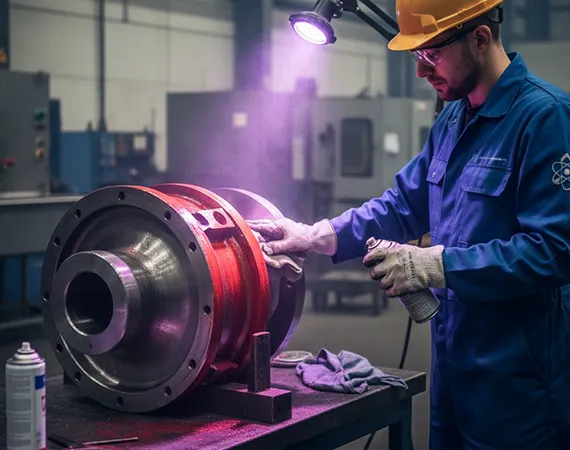
Dye penetrant testing is a highly sensitive method for identifying surface defects that are not visible to the naked eye, such as cracks, porosity, and fusion defects. It is used on metallic and non-metallic materials, provided they are non-porous, and is particularly effective for inspecting welds, castings, and machined components. The technique involves the application of a colored or fluorescent dye penetrant, followed by a wash and a developer that highlights the discontinuities. General Control CND performs PT tests using the colored or fluorescent method according to standards, both in the workshop and in the field, even on complex structures.

Magnetoscopic examinations (MT)

Objective:
Detect surface and subsurface defects on ferromagnetic materials.

How it works:
  1. Magnetization of the workpiece (with yoke or coils)
  2. Application of magnetic particles (liquid or dry)
  3. The particles accumulate at the defects
  4. Visual inspection (with visible or UV light)

Types:
  • AC: surface defects only
  • DC: also subsurface defects Fluorescent particles for UV light inspection

Advantages:
  • Fast, economical, highly sensitive
  • Excellent for welding, castings, and machined parts

Ultrasound exams (UT)

Objective:
Detect internal defects (cracks, porosity, inclusions) in metallic and non-metallic materials, even very thick materials.

Operating principle:
A transducer emits ultrasonic waves into the workpiece. The return time and amplitude of the reflected signal indicate the location and nature of the defect.

Advantages:
  • Detects deep and small defects
  • No damage to the workpiece
  • Precise and documentable method
Limitations:
  • Requires highly qualified personnel
  • Accessible and well-prepared surface
  • Complex interpretation on irregular geometries

Radiographic examinations (RT)

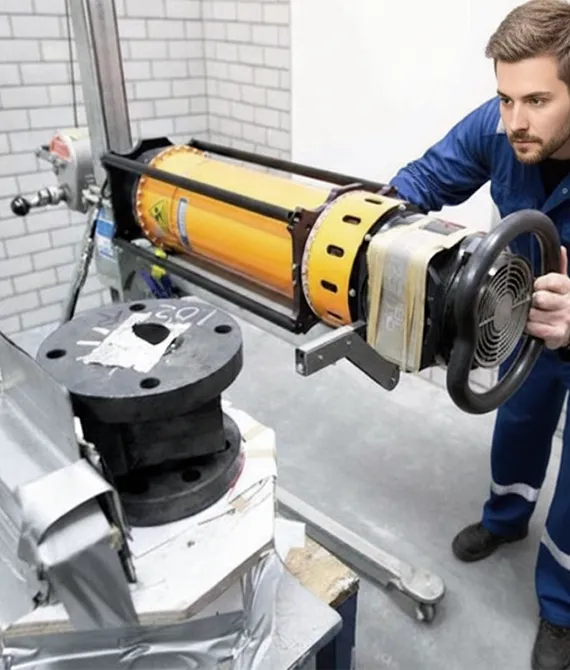
Our systems allow you to reliably inspect welds and internal components. We use gamma sources (Ir-192, Se-75) and X-rays with digital processing capabilities.
  • Weld inspection on pipes, tanks, and pressure vessels
  • Typical defects: cracks, lack of fusion, porosity, slag
  • Main standards: ASME, API, ISO
  • Typical thicknesses: from a few mm (onshore pipelines) to 50+ mm (offshore)
  • Techniques used:
  • X-rays for thin thicknesses
  • Gamma rays (Ir-192) for field work
  • Environmental conditions: often performed in the open field, even in ATEX environments
  • Digital imaging (DR/CR) increasingly used for speed and quality
Radiographic inspection is one of the most effective and precise techniques for identifying discontinuities Internal defects in metallic materials and welds, such as porosity, inclusions, cracks, fusion failures, and volumetric defects.
Through the use of ionizing radiation (X-rays or gamma rays), an image of the internal volume of the part is obtained, which can be visually examined on traditional film. General Control CND uses analog radiographic (RT) systems depending on the type of inspection, the required regulations, and the logistics of the site.

Phased Array (PAUT)

Objective:
Detect and characterize internal defects quickly and accurately, with angled scans and volumetric mapping of the part.

Operating principle:
A probe composed of many separately controlled ultrasonic elements. The electronics vary the angle and depth of the beam, allowing to "scan" without physically moving the probe.

Advantages:
  • Angled and customizable scanning
  • Intuitive 2D images (B-scan, S-scan)
  • Wide and rapid coverage
  • High sensitivity and resolution
  • Data can be digitally archived
Limitations:
  • More expensive equipment
  • Advanced training required
  • Complex calibration

TOFD

Time-of-Flight Diffraction is an advanced nondestructive testing technique that uses ultrasound to locate and characterize defects, such as cracks or inclusions, within materials, particularly in welds. This technique is particularly effective in detecting and precisely measuring the location and size of internal defects, offering advantages over traditional methods.

How it works:
TOFD uses the principle of ultrasonic wave diffraction. An ultrasound beam is sent through the material, and if a defect is present, the waves are deflected (diffracted) by the edges of the defect. By measuring the time of flight of these diffracted waves, it is possible to determine the location and size of the defect.

Applications:
TOFD is widely used to inspect welds, but can also be used to inspect other materials and structures, such as pipes or pressure vessels.